Guide to Purchasing Prints

Purchasing a high-resolution panorama print represents a significant investment, so it’s important to make informed choices when you choose print options and which print(s) to buy. This section is intended to provide you with the information you need to choose the print and the print options that are right for you. The section is organized in a FAQ (frequently asked questions) format, which we hope will make it easy for you to find the information you’re looking for. If you’re unable to find the information you need, please contact us directly by phone, email or the web form on our contact page. Thanks for your interest in purchasing a high-resolution panorama print from bobcphotography.com.
About Our Prints
All of our prints utilize the highest-quality materials and are manufactured to exacting standards. Features of our prints include:
Museum-quality, ultra-high resolution Lumachrome HD print, face-mounted to 1/8 inch UF-4 acrylic
1/8” acrylic backing
Diamond-milled satin-finish edges on all sides
Super-HD ROMA floating frame with French cleat hangers
Two border options: borderless and white border with caption
Three surface finish options: Clear Gloss, P99 Matte, and TruLife® Antiglare
Unique serial number with tamper-proof label attached to the back of the print
Unique edition number for each print of a given image
Signed Certificate of Authenticity
Signed information sheet attached to the back of the print
Free freight shipping to the 48 contiguous U.S. states
Limited lifetime warranty
Common Questions about Our Prints
What options do I have when purchasing a print from bobcphotography.com?
We offer two sets of options with each purchased print: borderless vs. a white border and three surface finish options. Please see the details below.
What is the difference between borderless and bordered print versions?
Our standard print is a borderless image (a “full bleed” image in print shop language), where the image continues all the way to the edges of the print. A borderless print creates a beautiful, lifelike look, as if the image is an ultra-clear window into the scene.
For those who want a “dressier” look we also offer bordered versions of our prints. Our ultra-wide aspect-ratio bordered prints feature a white border on the top and bottom edges of the print, with a caption on the lower border. Several of our bordered images with less wide aspect ratios feature white borders on all four sides, and also include a caption on the lower border.
Borders on all of our bordered images are pure white in color and are typically 1-1/2 inches (3.8 cm) to 2 inches (5.1 cm) in width, depending on the size of the image.
The images below show one of our ultra-wide aspect-ratio images, “Drifting Thunderhead,” in both its borderless and bordered versions:

“Drifting Thunderhead” (no border)

“Drifting Thunderhead” (white border on top and bottom, with caption)
Please note that the borders on our bordered images are not separate cardboard matte pieces. Rather the borders are part of the image and are thus “built-in” to the print. We don’t crop the image when we add borders, so our bordered images are slightly larger than the borderless versions, which adds a bit of cost to the bordered prints.
Why do most of your bordered prints only have borders on the top and bottom of the image?
Bordered prints of many of our widest aspect-ratio images don’t have borders on the ends simply because we believe that the image is so wide that the bordered version looks better without them. We think of the no-end-border look as an “infinity edge” - as if the scene continues indefinitely past the edges of the image. For images that are 120 inches wide, there’s also the practical consideration that the acrylic sheets that the print is mounted to are a maximum of 120 inches long.
The bordered versions of several of our images have borders on all four sides. Generally, these are images with less wide aspect ratios. Images with borders on four sides include “Fire Station No. 1,” “Pink Thunderheads,” “Baker Boyer National Bank,” “Spotlight” and “Pink Puffs.” The bordered version of “Pink Puffs” is shown here:

“Pink Puffs” (white border on all sides, with caption)
Bordered image captions: online pixelation vs. full-size and print sharpness
The unfortunate reality of displaying our images online forces huge reductions in image size and consequently, image detail. The greatly reduced sizes of our bordered images as shown online make their captions look blurred or pixelated. In fact, the captions on our bordered images are quite sharp when printed or viewed at full size, per the zoomed-in view below:

“Pink Puffs” caption detail
Which surface option should I choose?
We offer three surface finish options for all of our acrylic prints:
Clear Gloss
P99 Matte
TruLife® antiglare
Clear Gloss is our standard finish.
The question of which surface option to choose is in large part a question about how your print will be lit. If the print will be displayed in a place where the lighting can be completely controlled, i.e. where unwanted reflections can be fully eliminated, we recommend the Clear Gloss finish. The Clear Gloss finish offers stunning viewing clarity, yet it’s also our most affordable surface finish option. The only disadvantage of the Clear Gloss finish is that it does show reflections if lighting isn’t well-controlled.
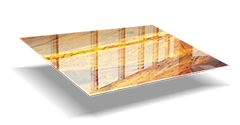
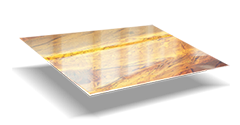
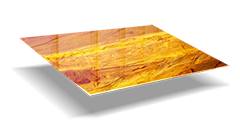
If your print will be displayed in an environment where lighting isn’t well-controlled, we recommend the P99 Matte (non-glare) finish. The P99 finish still provides superb image clarity with acrylic prints - especially prints that are made with the Lumachrome process. (All of our prints are Lumachrome.)
If your lighting environment includes uncontrolled ambient light such as window light or room lighting that wasn’t designed to light your print, the P99 Matte option does a great job of controlling any reflections from ambient lighting sources. In uncontrolled lighting situations the non-glare properties of the P99 surface option bring out the subtleties of acrylic prints because there are no external reflections to interfere with the light that the image itself reflects.
Finally there’s our TruLife® surface finish option. TruLife® is the gold standard among surface finishes in acrylic printing; it provides exceptional image clarity while still controlling reflections extremely well. The biggest disadvantage of TruLife® is that it will cost you some gold; it’s our most expensive finish option. There’s a lot of debate in the fine art printing community about TruLife® vs. other surface finishes and whether TruLife® represents the best value in acrylic finishing. But for those who insist on the very best, TruLife® delivers; that’s why we offer it as an option.
Why do you only offer acrylic prints? Are other materials or printing methods available?
We only offer acrylic prints because we want our images to be displayed at the highest possible level of quality. All of our prints are face-mounted Lumachrome acrylic because of the stunning clarity and detail that Lumachrome acrylic offers; other materials and processes can be quite good but they don’t quite match acrylic. Face-mounted acrylic prints are so stunning in terms of clarity and vibrancy that they almost appear to lit from behind. That’s the level of image quality we want all of our images to provide.
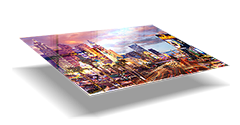
Lumachrome HD Acrylic
Image courtesy of Nevada Art Printers
A lot of the prints you offer are quite large. Are smaller versions available?
Our prints are large because that’s the size they were intended to be when captured. A key objective of wide-format panorama photography is to capture and present an image that fully depicts the scene it represents, in terms of both size and detail. We don’t currently offer reduced sizes, but some of our images are natively smaller than others. Consider images like “Pink Puffs,” “Castle Dome Thunderhead” or “Staccato Strata” if you’re looking for moderate image sizes.
Are custom framing options available?
All of our prints come standard with a rear-mounted floating frame, which we feel represents our images in the best way possible. However we are willing to consider certain custom framing options at an additional cost. Contact us for a quote.
What comes with a purchased print?
Each print comes with the following:
A Super HD Roma floating frame
Two French cleats for wall-mounting
A signed Certificate of Authenticity (not attached to the print)
2 copies of a signed information sheet; one is attached to the back of the print; the other is separate
A Thankyou card
The Certificate of Authenticity, the separate information sheet and the Thank you card come in a separate envelope.
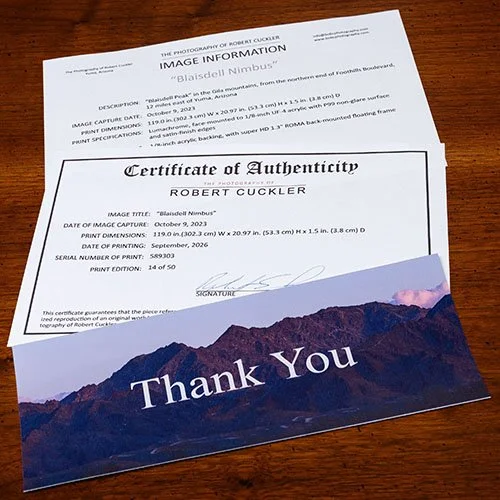
Do you sign your prints?
I don’t sign the viewing side of our prints because I don’t want anything to interfere with the integrity of the image. I do sign the information sheet that’s attached to the back of each print, so my signature is on each print that we make. I also sign the Certificate of Authenticity.
Do you offer limited edition prints? How can I be sure the print I purchase will hold its value?
All of our prints are open editions; we want to make each of our images accessible to as many folks as possible. However, buyers of our prints can maximize the value of their purchase by acquiring an early edition. We assign an edition number to each print of a given image, and that edition number is printed on the information sheet attached to the back side of the print. So the first print purchased would be edition no. 1; the second would be edition no. 2, and so on. One would expect that early editions, e.g. the first 10 or 20 would eventually become more valuable than later editions.
What is the typical delivery time for a purchased print?
Our standard lead time is 6-8 weeks from the time the order is placed.
Why does it take so long to deliver a print?
We apologize for the long lead time for production and delivery of our prints. Our printshop has a huge workload and a significant backlog. Also, their production processes are exacting, as are their quality assurance procedures. Shipping is via freight, which isn’t as fast as other package delivery services.
What are typical shipping costs of your prints? Can shipping be expedited?
We offer free shipping for all of our prints to destinations in the 48 contiguous U.S. states. Given the sizes of our prints, virtually all of our shipments are via freight. We can offer expedited shipping on certain prints at an additional cost. Please contact us for a custom quote.
Do you ship internationally?
Our current pricing is based on shipping to the 48 contiguous U.S. states. We hope to add offshore and international shipping to our standard offerings soon. We’re willing to consider custom offshore and international shipments but there would be an added cost. Please contact us for a custom quote.